Showing posts with label shaving horse. Show all posts

Saturday, December 9, 2017

Plans now available for the Mk III Combination Shaving Horse and Bowl Carving Bench.

At last, I have completed the plans for the awesome MkIII Shaving Horse and Bowl Carving Bench Combination.These plans are now available for purchase. This device has received considerable interest since I first posted about it in May 2015:
Combining a Shaving Horse and Bowl Carving Bench - My "Mk III" Shaving Horse.

The plans I have produced are comprehensive, consisting of nine A3 pages made up of scale drawings and some photos, but you can always print them out in A4 if you wish. Available in pdf format, the cost is AUD$50, which at the current exchange rate is approx. US$37. To all those who have been waiting, my sincere apologies. I had hoped the plans would be available on my hew website, but this is not yet operational. So rather than have you keep waiting around, there is a way forward here:


To purchase these plans, you can go to either our ETSY Shop 
Kind regards,
Greg Miller, 9 December 2017.
She's a beautiful thing, powerful and effective as a Shaving Horse.

The Auxillary Vice and Post enable bowls to be gripped on edge when shaping the outside. 

The folding wedge and end stop system on the solid bench grips bowl blanks nicely for hollowing with an adze. 

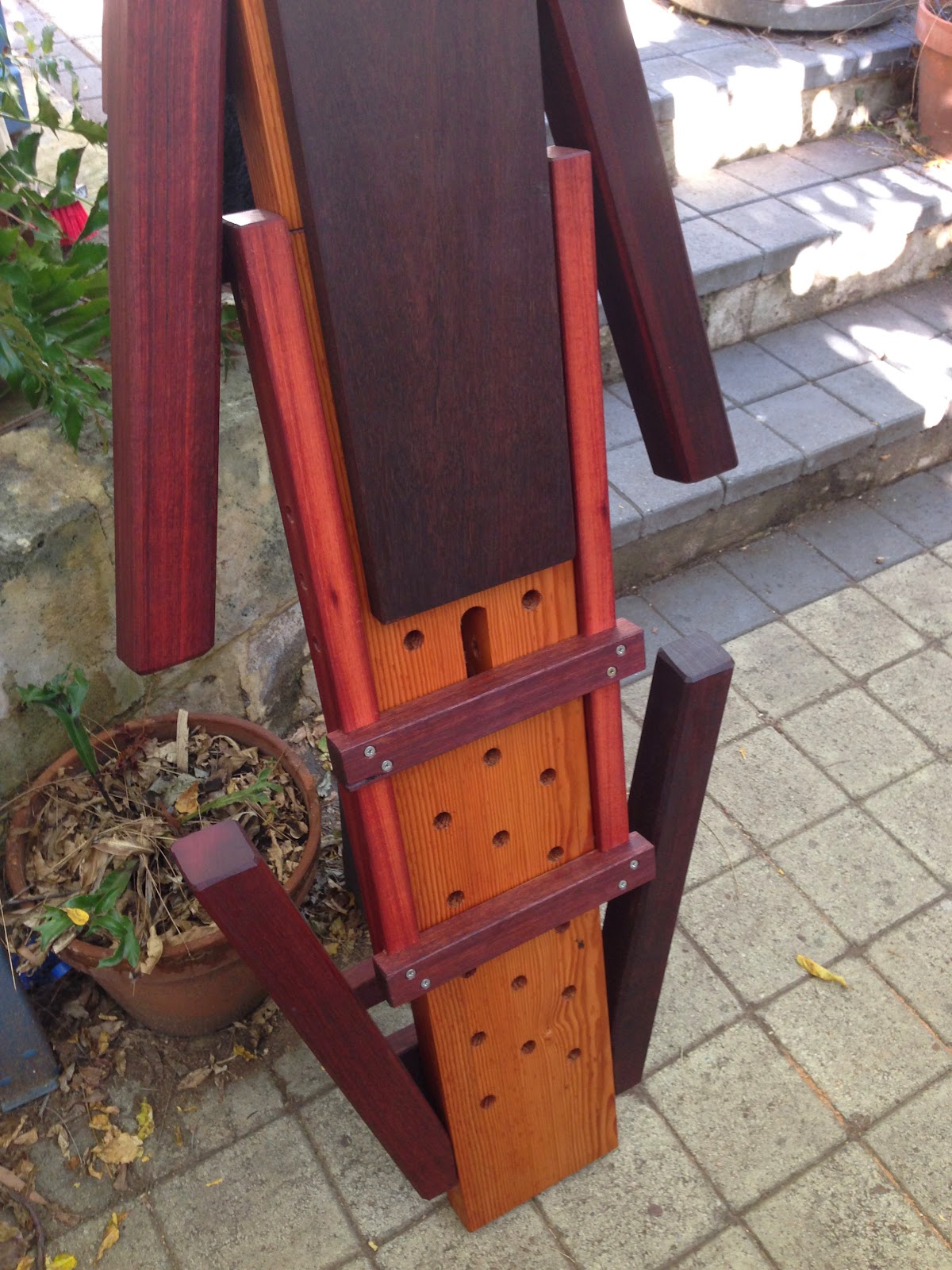
It all folds away, with the legs fixed back flat for transit. Very handy.


Friday, May 29, 2015

Combining a Shaving Horse and Bowl Carving Bench - My "Mk III" Shaving Horse.

I've got about 8 shaving horses, which I use for running public workshops. I had previously made a batch of shaving horses from packing crate material and other recycled wood, which I did a post about  in July 2014.
Since then I have made another version, like a super-modified saw horse. Let's call it the Mk II - a multifunctional shaving horse and bowl carving horse combo. My favourite horse, it is about 7 feet long, has fixed legs, and a heavy vise built into the tail of the bench. All this limits its portability.
Some of the original shaving horses, English Bodger style on the left and Dumbhead style on the right.

The Mk II Shaving Horse / Carving bench combo. A beautiful beast - with a tail vise!
The Mk II has fixed legs, as it is a supermodified saw horse at it's core. Being all jarrah, it is heavy. It is very versatile in its holding capacity, but there are times when it is too big or tricky to transport. 

I was invited by Timbecon to demonstrate Green Woodworking at the Brisbane "Timber & Working with Wood" Show on 15-17 May 2015. With my gear needing to be transported three thousand kilometres across the continent, I had the need to make a portable and versatile bench fairly quickly to catch the truck. Hence the Mk III was conceived. I was going to Brisbane, as the Mk II was not going to be friendly to ship on a pallet of stuff.

OK, so lets make a shaving horse combo which will be easier to ship. This means its got to have folding or removable legs...

Deciding on the Characteristics of the Mk III.Shaving Horse.
I built my first shaving horse, Mr Smiley, at the legendary Roy Underhill's Woodwright's School in North Carolina in late 2013. This was a classic "dumb-head" style, made entirely by hand from timber we mostly extracted from the forest using cross-cut saw and axe, then fashioned with side axe, adze, shaving horse, draw knife, brace and bit, etc. Amid the stable of horses at Roy's, there were a couple of shaving horses of the English Bodger's style. I particularly liked this style.
Me using Mr Smiley. I left him in Roy Underhill's Woodwright's School stable. 
Mr Smiley, with embedded Australian $2 coins for eyes. 

Horse-cam. Making Mr Smiley's walnut legs on an English Bodger's style shaving horse at Roy's.
Not sure why, but I seem to prefer the English Bodger's style of Shaving Horse. Hence the Mk II and Mk III were both made in this style.

Veritas Tools used to have free Shaving Horse plans available on their website, which I saw before planning the Mk II. One of the things which caught my eye was the use of the back end of the bench/seat for additional holding options. Now there was an idea...


When doing bowl carving, I have been using a very low wide-topped saw horse which has dog holes in its top for gripping he bowl blanks. What if these functions were built into the back end of a shaving horse? When I made the Mk II, I even installed a big vise in the back end of the bench. Awesome.

As the Mk III was to be portable, I would make the horse a little shorter than the MkII, put a twin row of dog holes in the bench for bowl carving, and not install the vise (which would add a lot to the weight).

Of course, it would be made from recycled wood. I happened to have a couple of ancient house beams, of Oregon (known outside Australia as Douglas Fir). I docked one of these to length, dressed the stick, and bored dog holes in it. It would be a nice solid bench/seat. Jarrah would be used for the legs, treadle frame, the ramp, and the bench accessories. The legs would fold, and be held flat to the bench when packed flat, using a couple of coach screws. To put up the legs, undo the coach screws, fold the legs out, and wind in the same coach screws in at the base of the struts. Solid as a rock.

The horse/bench folded flat, with all the accessories.

Fold up the legs, and wind in the coach screw at the base of the prop.
The assembled shaving horse. A rotating head on the treadle frame.
Variability with 3 hole positions in the bench, and 3 holes in the treadle frame.
Rotating head, and a sliding support block under the ramp.
Bowl holding on edge. The foot vise is fantastic. You sit behind the end post.
A couple of sets of folding wedges and side blocks.
Great gripping power when adzing out bowls.
Holdfasts go well for holding work too.
Not a bad beast. Solid, reliable, and versatile.
It's also much easier to ship and to pack away than the Mk II.
You still need a small box to hold the bolts, head, and accessories.
The Mk III takes about 5 minutes to assemble, creating a very solid saving horse, bowl carving bench, and general low bench. ... I do miss that tail vise though!

I love the way ideas evolve...
The Mk III was test driven for the first time at the Brisbane Wood Show. A nice horse too.
The film crew from QUT did a story around my demo area.
Here you can see the Mk III in action, ridden by Bernie the Journo.
This pic gives an idea of the size of the horse.

Don't worry, I am already thinking about the possible characteristics of the Mk IV!!
The buzz-"phrase is "Continuous Improvement", isn't it?


Note:  GOOD NEWS!
It is exciting that so many people are interested in Green Woodworking.

As a consequence I have been contacted by an overwhelming number of people seeking more info and measurements for the Mk III Combined Shaving and Bowl Carving Bench.
You will be pleased to learn that I will have detailed plans for sale in the near future, soon after the upcoming launch of my website. Yes! A proper website after all these years! This should be on line before Christmas 2017. There will be other plans available too, and other resources, as I am always cooking up new devices, like my new Tilting Bowl Carving Bench. 

Here are a few pics of the prototype. A couple of tweaks and small changes, and this awesome device will also be up on the new website with plans available for sale.  


The bowl blank is held between the two end stops by a pair of folding wedges.

The Tilting Bowl Carving Bench has 4 angle positions in which your bowl blank can be held.
Flat (0 degrees), 30 degrees, 45 degrees and 60 degrees. 

Work raised in the 60 degree position. It also can be held at 45, 30, and 0 degrees (flat, as per the previous pic)


In the flat position it is also good for paring with your gouges after the adze work.


Remember, Folks, plans for the MkIII Shaving Horse (a combined Shaving Horse and Bowl Carving Bench) and the Tilting Bowl Carving Bench will both be be available soon just after the launch of our new web site - along with other plans, plus lots of free information and inspiration to help you on your green woodworking journey.

I just love to share the joy of traditional woodworking with others.
Wood is a gift from the trees. Honour the trees by making beautiful things from them.

Greg Miller, Perth, Western Australia.  31 October 2017.   

Note: the plans are now available to purchase. They are quite comprehensive, being 9 A3 pages made up of scale drawings and some photos, but you can always print them out in A4 if you wish. Available in pdf format, the cost is AUD$50, which in the current exchange rate is approx US$37. To all those who have been waiting, my sincere apologies. I had hoped the plans would be available on my hew website, but this is not yet operational.

To purchase these plans, go to our Etsy Shop!
Kind regards,
Greg.


Wednesday, August 6, 2014

Enjoying a "Taste of Green Woodwork" Workshop.

At the end of June, I had the pleasure of running another Green Woodworking workshop. This time we used the Vic Park Arts Centre as the venue. On a nice sunny day, it was great to be able to work out in the garden and on the verandah.

Front side of the info flyer for the June workshop.
Calling it "A Taste of Green Woodworking", the ten participants had a choice of either bowl carving or spoon carving. The wood we had to play with was Cape Lilac and Camphor Laurel.

Here are a few pics from the day:

That's me doing a demo on cleaving some Cape Lilac with froe and beetle.
Another lovely spoon taking shape.
Doing a demo on hollowing out the bowl shape with an adze.
A Camphor Laurel Bowl in the making.
The Shaving Horse is a joy to use!
The small bowl carving adze is a beauty.
A moment of contemplation...
Working on the verandah.
There were an assortment of hatchets and adzes to try out.
Shaping the outside of a Camphor Laurel bowl with a hatchet.
Using a Hook Knife to hollow the bowl of a spoon.

It's a very relaxing pastime carving spoons together.
While not every creation was completely finished, it was a great day working green wood together. 
 Pre-industrial woodworking. What a hoot! So interesting - and such fun!

The next Green Woodworking Workshop will be a 2 day affair, on two consecutive Sundays in September. We will be making both a three-legged stool and a spoon over that time.

Here is the front side of the flyer:


Sunday, July 6, 2014

Make a shaving horse from recycled wood!

While traditionally a shaving horse would be made from green wood gathered from a forest or wood somewhere, not all of us city dwellers have easy access to the right kind and size of trees for this purpose. However, we do have access to wonderful seasoned timbers from all around the world which arrive in our cities in the form of packing crates, dunnage, and pallets. What a resource to work with!


Packing for the picking. Off the verge and into the back of the ute. Nice pine from the USA.
Earlier this year, I was needing to make up a few shaving horses for running workshops. So I started out by using some of the packing crate material I had collected which was in my timber racks.

Two models: the English Bodger style and the fabricated Dumb Head style.
There are many variations on shaving horses, though the most common styles would be the "Dumb Head" style, which has been around since at least the 14th century,  and the English Bodger's style which is a more recent (18th century) type of shave horse.

Making the Dumb-Head Style of Shaving Horse.
While I was in the USA last year, I used a fabricated dumb-head version while at the wonderful Roy Underhill's Woodwright's School. It was pretty much the same as this old plan by the legendary Drew Langsner, of Country Workshops, where I also spent some time while in the US. A big stick of timber I had would lend itself to making some of these.

shaving horse
While I found this kicking around on the internet, thanks anyway to Drew Langsner for the plan!

There was a nice long stick of timber in my possession, of some kind of Northern Hemispherical softwood, with Belgium stamped on it's IPSM 15 Mark. I had 6 of these sticks originally, which had come into Australia as dividers creating two layers of goods inside a sea container from Europe. Each was 7"x3" in section, 5.2m long. Yum. One of these would give me three 1.6m bodies for this style of shaving horse. Shown below after being docked up.


One long stick (5.2m) of some Northern Hemispherical softwood, here cut up to give me 3 shave horse bodies.

This "dumb-head", attached to the lever leg via a removable wedge, made from WA Blackbutt (Eucalyptus patens).
This version of a shaving horse I made to be collapsible. This would make them easier to store and easier to cart around. The four legs on each horse would be removeable as would be the lever leg. Hence the use of a wedge to hold the head onto the lever leg. Remove the wedge, slip off the head, take our the pivot bolt, and remove the lever leg. Piece of cake.  

Once part of a New Zealand manufactured bed. Now the lever leg of a recycled wood shaving horse.
It's great when a piece of recycled timber clearly tells something of its former life. I had pulled apart a bed someone had chucked out on a verge clean-up. Looking like interesting timber, I had picked it up and brougth it home for recycling. It happenned to bear a stamp from its manufacturer - made in Christchurch NZ in 1979. Love that 5 digit phone number! This bed was born the same year as my first child. This stamp is clearly visible now on the lever leg of a shaving horse.

My dear old Dad driving legs into the underside of a shave horse. Doug just turned 85. 
    The tops of the legs are tapered, to suit the tapered mortices in the body of the horse. While this helps to ensure they are removeable, I have found since that every now and then a leg drops out when you pick it up to move it. A small trade-off for portability, I guess. The tap of a mallet houses the leg, and the sideways whack of a mallet dislodges the leg. 

Completed dumb-head shave horse, with extended foot plate on lever leg.
 These shave horses work really well. Portable too. ...Fantastic.
This pics shows a lever leg without the extended foot plate.
The legs were made from some 30mm square blanks I have had for many years - originally for making Campaign Chair rails. Mostly sheoak (Casuarina sp.) and some WA Peppermint (Agonis flexuosa). Recycling old stock from my timber shorts rack - well they had only waited 20 years to be re-purposed! One day I will replace them with heavier looking legs - only because they will look better. The rest of the horses are made from packing crates, recycled furniture, and off-cuts from my joinery business.
This one has a nice chunk of jarrah for the head. Beautiful.
Thus far I have made 4 of these dumb head style horses. While the bodies are the same, each one has a slightly different lever leg, head and wedge. It all comes down to the variations in the bits of timber I pulled together to make the components up.

The perfect place to be using a drawknife... 
For the Green Woodworking Workshops I'll be running, I need to end up with about 12 shaving horses. I hope to have half a dozen of each of the two models of shaving horses. This way the workshop participants can expereince for themselves the pros and cons of each of the horse breeds.  


Making the English Bodgers' Style of Shaving Horse.
I had used one to these horses at Roy Underhill's last year, in North Carolina. A search on the net found the following plan from another legendary American Green Woodworker, Peter Follansbee.

Peter's plan was used to roughly base my bodgers' horse on.
It all starts with the right piece of wood, right? From outside a glaziers' warehouse, I had picked up a few boxes which had been used to import sheets of plate glass. From these boxes I had extracted some nice wide pieces of pine. Perfect for this type of shaving horse. It had been just waiting for the right opportunity to come along.
Such beautiful clear branding. This would have to be a feature! 
This timber was heat treated in the Arab Emirates, going by the ISPM 15 Mark so clearly branded on the packing crate. No idea where this pine grew, as it must have been imported into the Emirates in the first place. I wanted to ensure this branding would be clearly visible on the shave horses somewhere - a delightful testament to the fact that this timber had a previous life from packing crates.

Other pieces of packing crates used to make up the treadle frame. 
Unfortunately, I don't have many pics from the making of these horses.

View from the saddle. Nice blaze on this horse's nose! - the branding.
 The ramp is attached to the bed by steel hinges, mostly salvaged from old doors. The rise and fall of the ramp is altered by the block underneath, which is removeable for transport and can be slid forwards and backwards - thus changing the angle of the ramp and therefore the spacing between the horizontal of the treadle frame ramp. A nice action.  
These are a delightful horse to use. I have made three of them so far.
So there we have it... Two different horse styles, two different personalities.
I confess my favourite is the English Bodger's style. However, in retrospect I reckon these could have been made about a foot longer. You only notice this when working on longer pieces of wood, where you find your bum perches on the end of the seat. No problems, I still need to make more to reach my total of 12 horses.

Four of the shaving horses, two different models. All from recycled wood.
While it might be more romantic and 'true to form' to make a shaving horse from green wood, the eco-woodworker in me is delighted to be using wood predominantly rescued from the waste stream.

It is very easy to make a shaving horse from recycled wood. This wonderful tool, the shaving horse, has been used by chair bodgers, coopers, wheelwrights, wood carvers, spoon makers, basket makers, and so many other woodcraft workers - for centuries. By using wood rescued from the waste stream, and giving that wood a whole new life (Rather than just burning it or burying it in land fill) , I believe we bring honour to those trees from which the wood had originally come.

Soon I will make some more shaving horses... I can feel it coming on. It will be interesting to see what new breed emerges from this process. Stay tuned for a future post...