Friday, November 4, 2011

A few Joinery Doors in Croatia.

A recent visit to Croatia was fascinating. Amongst the wonderful sights and smells of this ancient and very much alive land with its layers of history, my eye was of course often drawn to joinery and furniture. Not the modern stuff, but the older stuff which oozes history and story.

Zagreb. So many amazing doors. Never mind the wheelie bin...
The thing about these fantastic wooden doors is that they do not exist on their own. The context is important, and that context is usually the doorway, which is almost always made of carved stone, which was the building material of choice for centuries before concrete took over in the modern era. With so much marbleine limestone around the place throughout the country, it makes sense that so much of this stone was used. Being so hard, it also has weathered really well. Hence you find buildings that are well over a thousand years old and still standing. This, for an Australian, is a certain fascination and cause of much wonder!

This door pictured in Zagreb isn't really that stunning, but it was the first one that I saw. I included it here as it marks the start of my journey of fascination with the joinery doors...

As we travelled from Zagreb down through Istria and the Dalmatian Coast and on to Dubrovnik, I found many interesting joinery doors which took my fancy.
Buccari. Not grandiose, needing maintenance, but oozing stories.

Buccari. Nice metalwork to compliment the beautiful wooden doors.
Buccari. Different door style, housed in a once-grand doorway with pediment.
Zadar. Interesting door panels. Fantastic stone surround! 
Oh yeah. Great door panels in the doors pictured above.
A closer view again ... to check out the methodology in the raised panel.
The technique known as "frame and panel construction" has been around for centuries, and continues to this day to be one of the most reliable and durable ways to construct doors, furniture, panelling, and a wide array of other joinery. Panels housed within a fixed frame are able to move independently as they respond to changing moisture content of the air. Very effective and very smart, offering structural stability and durability. In the closeup above, you can see that the whole raised panel is carved from one piece - with the exception of the beads in the small triangles, which are "planted". ie. fixed on. The different grain direction is the giveaway when it comes to investigating the construction methodology. The horizontal pieces of planted bead in the small triangles are not able to shrink in length as the width of the panel decreases in drying out. This has most likely lead to the splitting of the big panel which is visible down the centre right side of the panel. Interesting...
Zadar. Less fussy in design, and obviously being maintained.
Trogir. Beautifully detailed and ornate doors. Delicious. Nice surround, too!
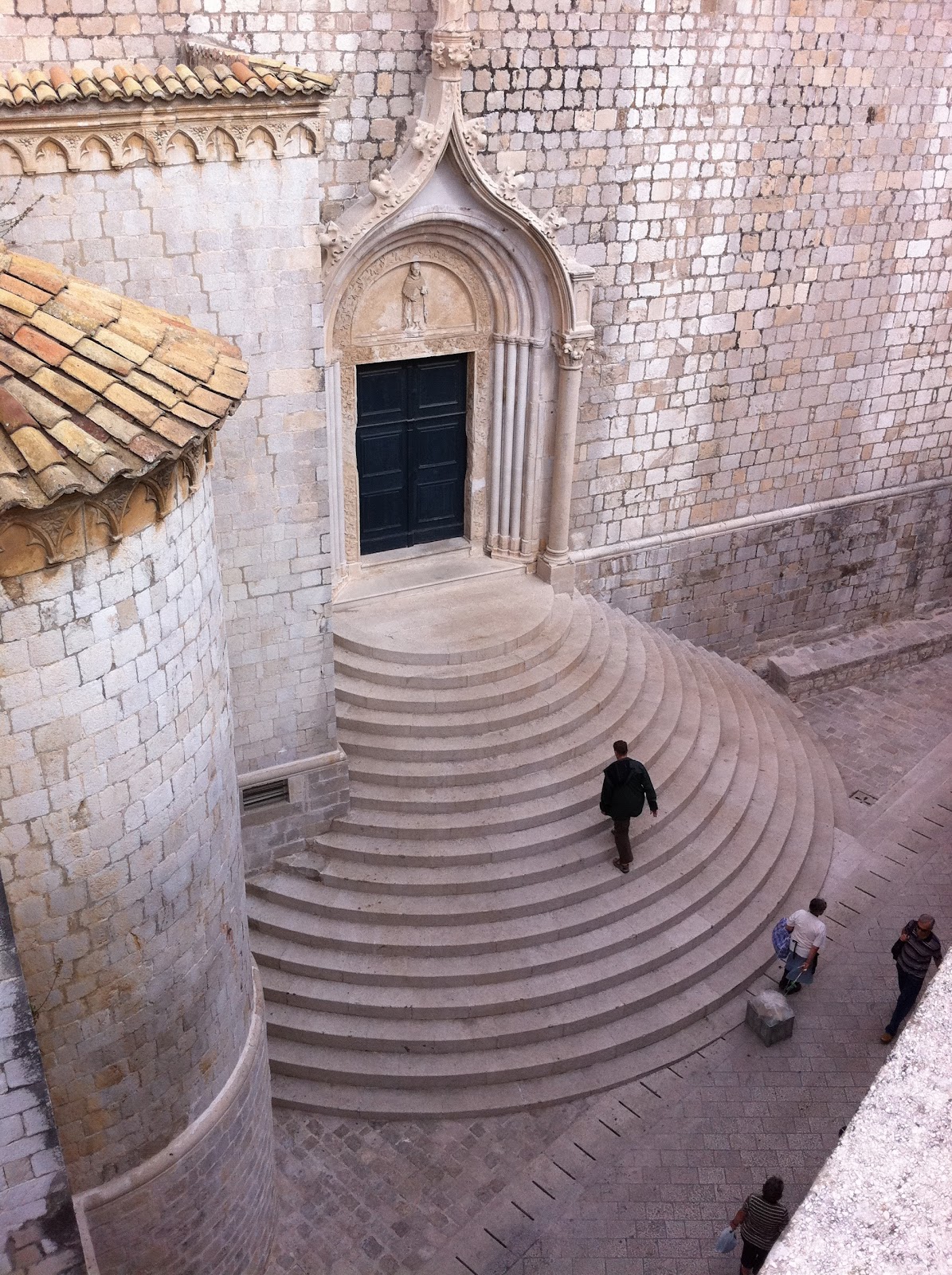
Dubrovnik. Never mind the doors, check out the approach stairs!
Dubrovnik. Four big carved panels. Nice job.
Dubrovnik. The fan-like overhead panel is wonderful.
Dubrovnik. Nicely different decorative door panels.
Dubrovnik. Diminished glory, showing a recent minimal repair job. Please fix me up!
Another pair of doors screaming for maintenance. Bottom rails needing replacement!


While some door scream out for maintenance, others speak of modifications that have taken place to them. These are not always beautiful or good for the doors, but do speak of a need for practical or creative solutions required by the householder.  Looking closely at the door tells us a lot...

Dubrovnik. Mis-modified? Bottom of the doors chopped off to make them fit into the doorway

Dubrovnik. Also modified. Bottom sections have been added on to the  original doors.
Dubrovnik. Another pair of doors modified at top and bottom rails.
Note how the doors have been scribed around the doorway. Unusual modification to make the doors fit doorway.
Dubrovnik. Nice detail, metal grill, and detailed planted stop down the centre.
Detail showing the top of that planted stop. Lovely scroll, eh?
Dubrovnik. This pair more modern and unusual in that the stiles do not go full length.
Yes, I have many more pictures of doors and doorways. Just a few are shown here.

What is it about doors and doorways? Each is an entry statement in itself, and speaks of the many owners and occupants of those buildings over the centuries or decades. As the principle point of entry and exit to a building, they take a lot of wear and tear. This activity produces scars which tell stories. The modifications also speak volumes. Many of the doors around Dubrovnik would have been damaged during the relentless shelling of the city in 1991-95 during the conflict, so it is not surprising that there were so many modified doors, from the rebuilding of the city in the aftermath. 

Ultimately, a good pair of doors will last almost indefinitely, so long as the construction is sound, they are out of the weather, and the maintenance is carried out. |Long live the beautiful doors and doorways in Croatia!

Friday, October 14, 2011

Inspired woodworking.

While travelling, I can't help but notice wonderful woodwork everywhere. Here's some examples of some found in two different locations, inspired by the spiritual and created by talented craftsmen a very long time ago.

The Blue Mosque, Istanbul.
This beautiful building was built for the Sultan Ahmed, and was completed in 1616. Inside this very impressive building are 200 stained glass windows the inner surfaces of the domes and walls are covered with over 22,000 ceramic tiles.

In this place of worship the architecture, colours and details are fantastic. Of course, my eye is always drawn to any woodwork around the place. With so much carved stone and tiles, there was not a huge amount of joinery visible in the area that the thousands of tourists like myself can get to. However there were two pairs of beautiful doors at the back of the rear area that I was able to get near. Identical pairs, I managed to capture some pics of them with my trusty iphone4, despite the low light conditions.

Apparently the tiles have faded significantly over the last 400 years. It must have been totally stunning when it was first built.


One of the two identical pairs of doors at the rear of the mosque.
Closer view of the beautiful carved and inlaid panels in the doors.
Construction details : pegged mortice and tenon joints. Note the border stringing in the frame. Nice.
Frame and panel construction has been around for centuries as a very successful way of building joinery that happily accommodates the movement of timber.  I really wanted to open the doors to check out the panels from the rear to see how they were done... but of course that would have been a no-no...
Exit door hardware.
 On my way out the exit door to the mosque, I noticed the hardware on the massive timber doors. I couldn't get a pic of the doors, but I did snap a shot of the hardware. Love these old handles, locks and fittings. They all tell stories of the life of the doors and the millions of people who have passed through them over the centuries.
While I did not find a lot of woodwork that I could get near in the Blue Mosque, those two pairs of doors were very beautiful and oozed of very serious craftsmanship. They were definitely worth a mention.


The Cathedral, Zagreb.
Like a lot of these ancient European buildings, this huge building has a long history of re-builds and renovations, due to destruction by invading hordes, earthquakes, warfare, and periods of repair. The original cathedral was built in the 11th century. Wrecked by the Tartars in 1242, it was re-built and later had fortified walls built around it to protect it from the Ottoman Empire attacks. In 1880, a huge earthquake significantly damaged sections of it, so it had another major re-build. It is currently undergoing significant repairs on the two spires, as the carved stone is very corroded. The implication of this interesting history is that buildings like these are an interesting mix of styles and artwork. Unless you are an expert in such things, it means that the age of the woodwork inside will vary considerably and that knowledge is sadly not something I possess. However, it sure is fascinating!

A view of the inside of one part of the cathedral
The detail in the carved stonework is fantastic! One part of the entrance way.
Inside the huge pair of outer doors are these four oak inner entry doors.
The carved oak panels in the lower sections of the inner entry doors are wonderful.
These booths were exquisitely made, with linenfold panels, carvings and complex finials. Stunning.
More carved oak panels in furniture with complex inlaid details in both the panels and the frames.
Seriously solid pews throughout, heavily carved - each with the essential huge radiator underneath!
This pic's for my Dad, who has done a lot of organ building. Beautiful woodwork hiding way up there!
One of the things I love about well made functional wooden furniture is the patina and wear from use. The tops of the pew ends had serious wear from countless hands holding them as people went in and out of the pews over so many years. You run your hand on those places and join with those people in a sense of connectedness.  The pew seats are worn from thousands of people sliding their bodies off and on the kneelers in front. I love all that wear and the stories that it tells!

Over the years I have been commissioned to make and repair a range of furniture for places of worship. While I always seek to create the best level of craftsmanship in all that I make, when making these commissions I feel a heightened sense of responsability to do it right.

I am sure that all the craftsmen over the centuries who have participated in the creation of these amazing buildings and their furnishings have also felt the same...
... I reckon there's something in there about giving back to the One who gave us the trees, the beautiful woods that are derrived from them, and the joy of making things of great beauty and function with our hands.   
 

Monday, September 19, 2011

The mystery No 7 Stanley Plane.

What a beautiful plane!

I had been looking for another No7 Jointing plane for my group participants to use. I came across one at my local markets recently, which I snapped up for AUD $50. A good price for a "user"- but there was something about this plane which seemed odd, and I just couldn't put my finger on it at the time. There were several indicators which told me this was an old plane.

Stanley bought the patents for the adjustable metal plane from Leonard Bailey in the 1860s. The name Bailey was later cast into the plane bases in front of the knob in honour of Mr Bailey. The name Stanley does not appear anywhere on the plane, except for on the plane iron. The iron (blade) lettering says it was made in Australia by Stanley. The Stanley Works in Australia was located in the southern state, Tasmania.

DATING THE PLANE.
By digging around on the internet across a range of sites, I was able to put together a few clues as to the age of the plane. While I can't claim to be 100% accurate, I reckon the following information is pretty close to the mark.  It may be of interest to you. I am always fascinated with old tools and the stories behind them. Of course, there is no way of knowing that all the parts are the original! Hence it is worth checking out a range of attributes of this mystery plane. Let's have a close look at it...
There are three patent dates on the plane base:
March-25-02; August-18-02; April-19-10.


The frog design and the frog receiver cast and machined on the plane base was Stanleys third design, and was patented in 1902. This type was made between 1902 and the end of WWII. The first two dates relate to this improved design patent.
The third patent date was added to plane bases made between 1910 and 1918.

There is a low profile front knob.

Stanley started making the tall knob we are most familiar with about 1920, so this plane dates sometime before that.

The blade is laminated.
The laminated blades were made for decades right up to WWII. That piece of steel laminated onto the cutting end of the blade is incredibly hard! Re-grinding the bevel on my wet stone grinder took forever. Stanley called these "composite" blades. This one is of the version where the entire end of the blade was of the hard steel, rather than a thin layer bonded to the lower end of the normal steel of the plane iron.

The lever cap has a key-hole shaped hole.
During the 1930s, the lever cap was re-designed and patented, from the key-hole shape to the kidney shape.
That dates this lever cap before then.

So what is the verdict? The plane was made between 1910 and 1918. Is the iron the original one? Not sure - but I reckon everything else is original.

SOLVING THE MYSTERY.
While I knew it was old when I spotted it at the markets, there was something odd about this plane. When I got it home, I worked it out - when I put it next to my No7 (which was given to my Dad by his Father in 1945 when Dad started his Carpentry/Joinery apprenticeship.) Bingo!


The US made Stanley No7 in the background, and the "sawn off" No7 in the foreground.

The mystery No7 was over 3 inches shorter than the other No7! I can only assume the plane was dropped on its tail at some stage, and the cast iron base has snapped across the tail. The owner did a fantastic job of re-shaping the end, just behind the "No 7" cast on the base. Such a good job that I didn't pick it. It's a bit short! That's why there was something odd about it... but it is still an absolute beauty to use!
Henceforth it shall be known as the "Sawn-off Seven".

Sunday, September 11, 2011

Another Fantastic Earthcarer's Program.

A recent Saturday was a big day but a great day. I had been lined up to run two workshops with a whole bunch of Earthcarers, in the big shed at Perth City Farm. There were 20 places in the morning session, making Kitchen Chopping Boards, and 20 places in the afternoon session, Carving Wooden Spoons - and all 40 places had been filled ahead of the event. I don't usually work with groups that big, and pulling together the extra benches, tools and materials was a huge job. Aah, but we created some wonderful stuff!

Peg warms up the morning group as they gather with anticipation.
Earthcarers are keen recyclers, and the purpose of the program was four fold:
  1. To help the participants learn about trees, understand about wood, and appreciate the importance of wood as a low-energy renewable recyclable sustainable carbon-sequestering material.
  2. To help the participants understand the potential of "waste" wood and its usability.
  3. To empower the participants with some basic skills to be able to utilise some "waste" wood.  
  4. To discover the joy of wood and woodworking, while being creative and having fun.  
Morning Workshop:  Kitchen Chopping Boards from "Waste" Wood.

The proud makers of two chopping boards - One of highly figured jarrah (formerly a piece of hanger beam) and the other of european oak (formerly a piece of pallet).

Nice wood! A lovely board made from Silky Oak - once part of a discarded bookcase.

Delicious board made from european oak - another piece of that pallet. 

Once a piece of pine crate from New Zealand - the mechanically imprinted APSM 15 Mark here cleverly utilised.

Unknown tropical hardwood from a packing crate - now a very nice board.

A beautiful jarrah board taking shape - previously a piece of pergola timber.

Another good lookin' piece of recycled jarrah.
That was just a sample ... so many great chopping boards created from "waste" wood. For many it was the  first time they'd used saws and planes. That was the whole idea - to learn about wood, learn how to utilise it with some basic tool use, and to get excited about the possibilities each piece of wood offers. 

Afternoon Workshop: Wooden Spoons from "Waste" Wood.

There's something wonderful about hand making wooden spoons. Each person needs to establish a working relationship between themselves, the tools and the piece of timber. As you are shaping the wood from so many directions in relation to the grain, with a range of different tools, it is a great way to learn to work with the grain rather than against it. For each person it is an individual journey. For first time woodworkers, it is rare that the finished spoon is just as the maker envisaged or planned at the beginning of the process. Lots of things happen along the way which bring about design changes on the run!  However, the resulting spoons are fantastic expressions of their creator and their journey with the tools and their chosen piece of timber. The makers are normally very very proud of their spoons.

WA Blackbutt makes such beautiful spoons. This piece once lined the ceiling of a bathroom!
Each wonderful spoon is designed and crafted by it's creator. There's plenty to smile about!

A spokeshave is used to shape the back of the spoon bowl. Using all hand tools, you can feel, hear, and smell the wood responding to the tools. It's talking to you all the time. Listen and engage...
A great number of beautiful spoons were made that afternoon. I didn't get many pictures of the finished products, but the beaming smiles on the faces of the participants remain etched on my mind.

There are a few more EarthCarers out there now who have had a small taste of the joy of wood. 

...Yeah, I just love doing this stuff!

Tuesday, August 30, 2011

Recycled timber - a trip to the mother lode.

The other day I took a drive across the city to the Henderson Waste Recovery Park. (Affectionately known as the Henderson Tip.) The purpose was to gather up a ute load of timber from the awesome woodpile there.
One view of part of the pile. That's all plywood in the foreground.
In the past, "Rubbish Tips" were big holes in the ground into which all waste was dumped and buried. Those days are over now, increasingly replaced by Waste Recovery Centres, which aim to reduce the amount of material going into land fill by a variety of interventions. Much of the waste is sorted, and recycling takes place when there is a market for those materials or there is a use on site. Hence there is a huge pile of timber, in pile of its own in one part of the enormous Henderson Waste Recovery Park. This timber is currently used on site for mostly low value uses, where it is chipped up to create roadbase material across the enormous facility. It is hoped to one day have a higher value way of recycling this timber.  To a guy like me who is committed to recycling timber, who is forever pulling apart old furniture and shipping crates to extract the timber, a visit to this huge pile is like coming across the motherlode. With the Henderson Facility in close proximity to the Port of Fremantle and several  industrial areas, there is a large proportion of packaging material in this timber, from all over the world. Amongst it all is some amazing and wonderful timber, with the  the ISPM-15 marks telling what part of the planet the packaging has come from.  
I scored a nice heap of pine boards from a big pallet which originated from Mexico
Out of interest, the global standard ISPM-15, is currently being enforced in almost every major importing country in the world. After treatment, ISPM-15 requires that the heat treated pallets and timber packaging are marked in a visible location with a legible and permanent mark approved by the International Plant Protection Convention.
Compliance with ISPM-15 for wood packaging materials allows for two treatment options:
Heat Treatment (HT): Wood packaging material is heated in a schedule that achieves a minimum core temperature of 56ÂșC for a minimum of 30 minutes.
Methyl Bromide (MB) Fumigation: The wood packaging material is fumigated with methyl bromide.
ISPM-15 requirements apply to all species of coniferous (softwood) and non-coniferous (hardwood)
packaging materials.

"There's treasure in that there pile!"
I have several woodworking programs coming up specifically involving the use of recycled timber, so I went to the Henderson Tip with a bit of a "shopping list" in my head. I had some wins, a few bonuses, did not get all that I had hoped to find, but came away with a wonderful heap of timber. You have to be lucky. There is daily stream of trucks coming to to dump timber at the pile, and a zealous loader driver who periodically pushes the new deposits up into the huge pile which can be up to 10 metres tall. The menu is different on an almost daily basis, depending on what has come in. I came back with more plywood than I had expected, and less material suitable for kitchen chopping boards than I had hoped. However I was very happy!  
 So what did I come away with? A significant amount of plywood: 18mm, 16mm, 12.5mm, 9.5mm, and 4mm thick. Much of it Australian made, as wide rips off sheets 8 feet long. Much of this will be cut up into smaller pieces for the woodworking activities I do with kids. There was a huge pallet from Mexico, of 8 inch wide boards, which I pulled apart and brought home. This will be cleaned up and re-machined for the projects I have coming up with lots of kids in schools, making cheeseboards. I also obtained a heap of wide pine boards from Holland, Finland, New Zealand, and China. Some of these will be very useful for the programs I have coming up teaching woodworking hand skills to adults. They will saw, plane and shape these into a range of kitchen chopping boards.
However the material I mostly like for chopping boards are hardwoods. Sadly, other than a few nice boards from Indonesia, there was not much I could access on the day. Some I could see under tons of other timber, but was unable to remove them from the pile. Others I could see up on the top of the pile, but it was too unsafe to climb up there! All I could do was to gaze up and salivate.
Surprisingly, I did get some nice chopping aboard material from a pallet of unknown origin - but was clearly made from European Oak. Nice! Incredibly heavy, I was only just able to pull turn it over to be able to attempt to remove the boards.
That's my trusty Disston panel saw. Gives you an idea of the size. All that oak! 
Sadly, I was unable to remove the rusted heavy nails or lever up the boards, even using my big pinch bar, so I had to settle for cutting out a bunch of the boards between the gluts. It smelt like wine barrels as I cut it. A tragedy to leave so much of it behind, which I especially felt the next day after I had stuck one of the pieces through the thicknesser!
The trusty ute very much loaded up with treasure.
It's a lot of work to denail this stuff, much of which I did on site, and the remainder I did in my front yard at home on sawstools that evening. However, I am happy to be spreading the important message about improving our stewardship of timber which is being wasted every day. Along the way, I get to discover and use some amazing timber from all over the planet. I also get to introduce a lot of people to the joy of working with wood. Fabulous.